


Analysis Area: Busan Metropolitan City
Key Institutions: 10th Busan Metropolitan Council, Standing Committees, Special Committee on Budget and Accounts, Council Secretariat
Agenda: Verifying Congressional Capacity to Track Plans, Budgets, Schedules, Risks, and Future Outcomes of Large-Scale Projects on a Single Project Standard
Golden Time Type: Strategic Project Expansion + Oversight Continuity Risk
Reference Date: 2026.08.28
Version: Regional AX Golden Time Intelligence v3.2 Enhancement Standard
Busan City’s main budget for 2026 is 17.9311 trillion won, a 7.5% increase from 2025, and the first supplementary budget of 281.3 billion won and the second supplementary budget of 550.8 billion won have also undergone review by the City Council. The scope of financial verification by the Busan City Council has expanded beyond the annual main budget review to encompass a permanent portfolio including multiple supplementary budgets, funds, public institutions, and long-term projects. However, a public Legislative Runtime—which links total project costs, national, municipal, and private funding, schedule changes, contracts, related projects, and future benefits for each large-scale project under a single project ID—is not being verified. If project costs and schedules change repeatedly between 2026 and 2028, it becomes difficult to assess cumulative value and risk based solely on fiscal year-by-fiscal reviews. While the Busan City Council possesses the infrastructure for large-scale financial reviews, its life-cycle verification system for large-scale projects is deemed unconfirmed.
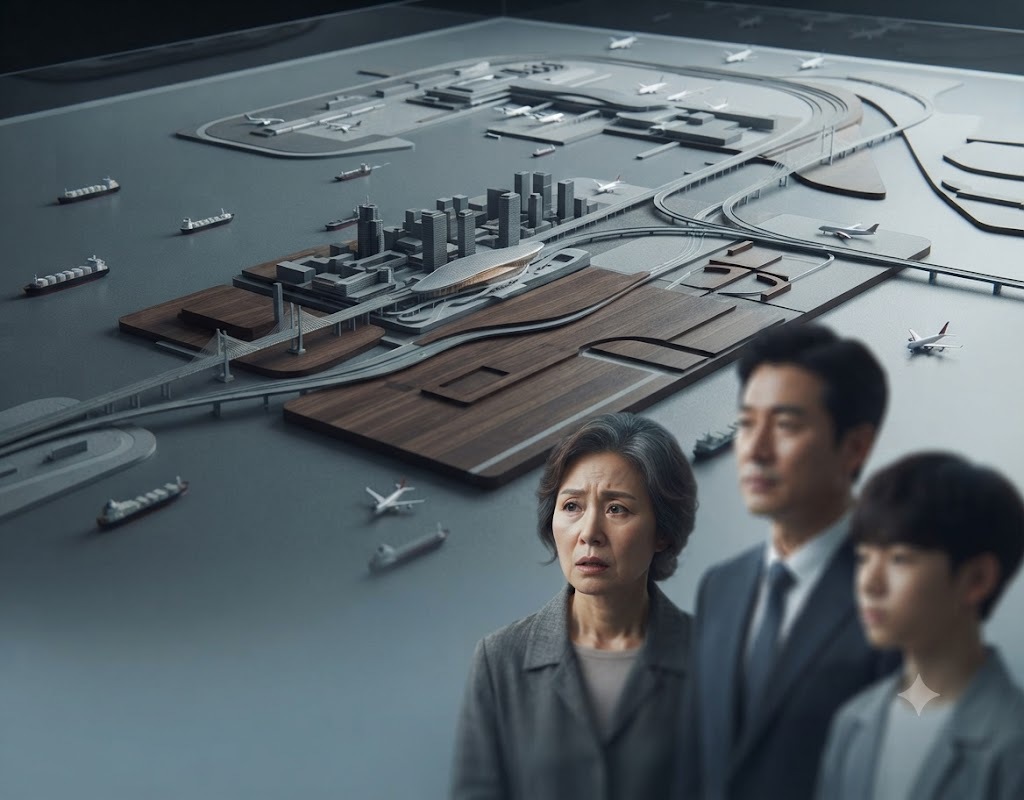
Following controversies over the failed bids for site preparation work, contract methods, and construction periods, the Gadeokdo New Airport presented a construction period of 106 months and a completion target of the second half of 2030 in its business report for the second half of 2026. In August 2026, the City Council directly inquired about the cascading impact of the revised opening date and the schedules for the hinterland city and logistics hub. This represents evidence that the unit of verification has shifted from the single process of the new airport to the simultaneous delays of the hinterland city, logistics, transportation, and industrial strategy. However, no publicly available data has been confirmed regarding the automatic recalculation of the impact of the schedule change on the budget, demand, cash flow, and benefits of related projects. If major contracts and linked development schedules become fixed for 2026–2028, it will be difficult to reverse the complex costs of the initial delays. It is determined that while the verification of the Gadeokdo New Airport has reached the stage of inquiry into current issues, it has not yet reached the stage of recalculating future value.
The North Port Redevelopment, Gadeokdo New Airport, Global Hub City, the relocation of the Korea Development Bank, and the administrative integration and super-regional projects of Busan and Gyeongnam are situated within distinct laws, budgets, agencies, and timelines. Busan's future projects have shifted from individual SOC infrastructure to a portfolio where airports, ports, finance, industry, and urban development are interdependent. While delays, feasibility, and linkage strategies were repeatedly questioned during the 2025 administrative audit and the 2026 work report, no publicly disclosed portfolio compared based on the same future value criteria has been identified. If partial optimization of each project proceeds over the next two to three years, a chain risk will accumulate where delays in one project lower the demand and benefits of others. Although the scope of the Busan City Council's verification is broad, the verification of cross-project future value is deemed incomplete.
The 10th Busan Metropolitan Council was inaugurated on July 6, 2026, and began reviewing work plans for the second half of the year and the budget execution status of major projects starting in July. Although the composition of the council has changed, the structure for the Gadeokdo New Airport, North Port, urban development, and industrial transformation projects inherits the decisions and contracts made by the previous council. However, an open Legislative Memory—which automatically transfers project-specific premises, past inquiries, corrective measures, and unresolved risks between councils—has not been confirmed. Unless an initial verification system is established for the 10th Council (2026–2028), signals of past failure in long-term projects will rely on searching meeting minutes and the experiences of individual council members. Currently, the "Golden Time" is determined to be not only the commencement date of large-scale projects but also the first two to three years during which the 10th Council finalizes its long-term verification memory.
Golden Time Thesis — The Busan City Council’s verification of future value is not a matter of reaffirming the necessity of a project, but rather a reassessment within the same project timeline of how the difference between the initial premise and current evidence has altered total project costs, schedules, demand, related industries, and citizen benefits.
Busan City is managing a 2026 main budget of 17.9311 trillion won and is pursuing projects related to transportation, welfare, urban development, industry, tourism, environment, safety, and education. The scope of verification by the City Council extends beyond the main office's budget to include funds, special accounts, public enterprises, equity investments, contributed institutions, private entrustment, and projects delegated by public institutions. However, no publicly available data has been found that links the direct budget, equity contributions, public enterprise investments, state funds, private investment, guarantees, and operating costs of a single project into a single total exposure. If complex financing projects increase between 2026 and 2028, the overall financial burden on the city could rise, even if individual accounts appear appropriate. Although the scale of the Busan City Council's financial verification is substantial, the total financial exposure for each project is deemed unconfirmed.
In 2026, the City Council reviewed the first supplementary budget of 281.3 billion won and the second supplementary budget of 550.8 billion won, in addition to the main budget. Financial management has shifted from a single annual main budget to a "runtime" system involving multiple adjustments based on changes in the policy environment. However, a publicly available timeline automatically linking the main budget, supplementary budget, carryover, unused funds, and settlement for each major project is not available. If supplementary budgets and carryovers are repeated over two to three years, the difference between the initial approved amount and the actual completed costs becomes dispersed across multiple fiscal years. While financial verification is currently being conducted repeatedly, the verification of cumulative costs for long-term projects is deemed to be in a fragmented state.
The Gadeokdo New Airport, North Port Redevelopment, Busan Station Railway Undergrounding, Global Hub City, Korea Development Bank Relocation, and West Busan Development are projects involving the joint participation of the state, the Busan Metropolitan City, public corporations, and the private sector. The project operational structure has shifted from a single executive department to a complex governance model governed by multi-agency agreements, laws, and national plans. A Council Portfolio Map disclosing agency-specific schedules, responsibilities, funding, and preconditions in a standardized format has not been identified. If inter-agency schedules diverge between 2026 and 2028, only the Busan Metropolitan City budget will be executed, potentially delaying subsequent investments from the state and the private sector. While the scale of large-scale projects is greater in inter-agency dependency than in individual budgets, it is determined that the Council's observation unit has not fully reflected this.
The Busan Metropolitan Council operates plenary sessions, standing committees, the Special Committee on Budget and Accounts, administrative audits, city administration inquiries, five-minute free speeches, and council member research groups. The verification mechanisms consist of a multi-layered structure that extends from a single budget review to legislation, audits, research, and on-site inspections. However, no publicly disclosed common cases have been identified regarding how multiple verification mechanisms share responsibilities for the same project and how follow-up measures are shared. Even if inquiries and research increase over two to three years, verification time is exhausted by repeatedly confirming the same risks unless they are integrated by project. While the Busan Metropolitan Council possesses verification mechanisms, the scale of integration between these mechanisms is determined to be unconfirmed.
The 2026 budget proposal was approved at 17.9311 trillion won, a reduction of 1.9 billion won from the 17.933 trillion won submitted by Busan City, while some projects underwent adjustments involving cuts or increases. This confirms the City Council's function of adjusting financial resources rather than simply passing the executive branch's proposal. However, the basis for disclosing how the adjusted amounts are linked to project outcomes, past execution rates, and future value analyses is limited. If only the results of the numerical adjustments for 2026–2028 remain, the long-term effects of the cuts and increases will not be connected to the next settlement of accounts. Budget adjustments are functioning, but there is a lack of public evidence to determine whether the adjustments are based on future value.
The delays in the Gadeokdo New Airport, the pace of the North Port redevelopment, the relocation of the Korea Development Bank, and the progress of the Global Hub City Act were repeatedly addressed in administrative audits and work reports. Council inquiries shifted from the mere existence of projects to the effectiveness of schedules, contracts, and linkage strategies. However, no structure was observed where warning criteria established in past inquiries are automatically compared in the work reports of the following session. When the same pending issues are repeated under different wording over two to three years, verification is not accumulated but is reset at every session. While the accumulation of legislative activities is confirmed, it is difficult to conclude that this has led to the growth of a project-specific learning ecosystem.
In 2025, the council member research group 'Busan Station' studied measures to enhance Busan City's fiscal soundness and efficiency, while the 'Busan Ordinance Research Group' re-examined ordinances based on their policy effects. Council member research has expanded from current issue speeches to the analysis of the structural effects of finances and ordinances. However, the rate at which research results led to specific ordinance amendments, budget adjustments, performance indicators, or project terminations is not disclosed. Once research projects for 2026–2028 conclude with session-by-session result reports, the gap between expert knowledge and actual decision-making persists. While a policy research ecosystem exists, the conversion rate from research to decision to outcome is deemed unconfirmed.
In the second half of 2026, the Standing Committee received reports on both major work plans and the budget execution status of major projects. The verification structure was expanded from plan approval to interim execution checks. However, no public disclosure system was found in which follow-up budgets, contracts, and performance indicators for projects with low execution rates or schedule changes are linked to automatic alerts. Over the next two to three years, as large-scale projects enter the implementation phase, the volume of information in interim reports increases, but the priority of warnings becomes unclear. Although the Busan City Council's verification has been extended to the intermediate stage of execution, a risk-based screening system is deemed unconfirmed.
The opening date for the Gadeokdo New Airport has been adjusted from the original end of 2029 to the second half of 2030, with a proposed construction period of 106 months. The valuation of this large-scale project has shifted from fixed completion benefits to a structure that repeatedly recalculates changes in costs, demand, and related businesses resulting from the delay. However, no publicly available parliamentary data has been found that integrates the impact of the opening delay on the present value of the hinterland city, air logistics, transportation access, and corporate attraction. Once the major construction schedule for 2026–2028 is finalized, certain risks will transform into the irreversibility of contracts and land use. While the verification of future value has shifted from the initial feasibility to the recalculation of value based on the modified timeline, the parliamentary runtime remains incomplete.
The North Port, airport, railway, finance, and tourism projects are premised on their respective completion times and demand. The future value of these projects has shifted from individual net present values to a structure that includes synergies between portfolios and the propagation of delays. However, there is no publicly available evidence confirming that the Assembly has compared, using a common scenario, the impact of a delay in one project on the benefits and budget of others. If individual committee reviews continue for two to three years, cross-project risks will not fall under the sole responsibility of any single committee. While the structural changes in Busan's large-scale projects are interdependent, the Assembly's verification is judged to be fragmented, conducted at the project and committee levels.
Changes in construction costs, interest rates, demand, climate, population, and technology alter the future value of large-scale projects annually. The scope of verification has expanded from the initial total project cost and completion date to include cost distribution, operating revenue, opportunity costs, carbon emissions, disasters, and population trajectories. However, evidence based on repeated calculations of these variables using the same business model is not found in the publicly available data from the Busan Metropolitan Council. If external conditions change between 2026 and 2028, the actual future value will differ even if past feasibility figures are maintained. It is determined that the Busan Metropolitan Council's verification of future value has not sufficiently shifted from static project descriptions to dynamic scenario verification.
AI and big data provide a technological environment that connects meeting minutes, budgets, contracts, processes, civil complaints, and performance by project. Legislative verification has secured the conditions to shift from individual council members' document searches and inquiry preparation to continuous risk detection. However, there is no confirmed public evidence that the Busan Metropolitan Council continuously operates Risk Scores and Milestone alerts for large-scale projects. As project documents accumulate over two to three years, it becomes difficult to compare past assumptions with current changes through manual review. While the technical feasibility of Legislative AX has increased, its actual application of continuous verification is deemed unconfirmed.
The Busan Metropolitan Council repeatedly verifies large-scale projects through budgets, settlements of accounts, administrative audits, work reports, and policy research. The scope of the Council's response has expanded from resolutions prior to groundbreaking to include execution, settlements, and follow-up reports. However, no open Oversight Platform linking this data to Project IDs, Milestones, and Outcomes has been identified. As meeting minutes and attached materials continue to increase for the 2026–2028 period, the gap between the volume of verification tools and the actual speed of risk detection will widen. While the current response is institutionally multi-layered, it is assessed as fragmented in terms of data operation.
The 2025 studies on fiscal soundness and efficiency, as well as the study on the policy effects of ordinances, represent a response that views large-scale projects in terms of sustainability and policy effectiveness rather than budget size. The scope of parliamentary research has shifted from explaining current issues to analyzing the long-term structure of finance and institutions. However, no public tracking tables confirming that research conclusions have been reflected in the next main budget, supplementary budget, or ordinance review have been identified. If research accumulates as independent outputs over two to three years, the same fiscal risks are repeated in other projects. While the response to policy research is confirmed, its diffusion into actual review tools is deemed unconfirmed.
During the August 2026 Gadeokdo New Airport work report, questions were raised regarding changes to the opening schedule and a re-evaluation of the hinterland city and logistics strategies. It is confirmed that the Assembly responded by expanding the issue of single-stage project delays to the future value of related industries. However, it has not been confirmed that the revised integrated schedule, costs, benefits, and responsible departments were disclosed following the inquiries. If the risk of delays recurs over the next two to three years, the disconnect between the inquiries and the implementation plans will widen. While the level of analysis in responding to current issues has improved, the traceability of changes to the implementation plan remains unconfirmed.
Immediately after its inauguration, the 10th Assembly reviewed the second-half work report and the budget execution status of major projects. Institutional continuity is confirmed, as the new Assembly immediately took over and verified the projects of the previous term. However, there is no public evidence confirming that the 10th Standing Committee managed the unresolved questions regarding specific projects raised during the 9th term and the executive branch's responses as a common takeover list. If the verification of long-term projects for 2026–2028 relies on the individual learning of new members, the transition to the 9th term will result in an oversight gap. While Assembly operations were continuous, the continuity of project memory is deemed unconfirmed.
The leading standard for long-term infrastructure verification lies in the continuity of independent cost estimates, phased Gate Reviews, risk registers, change management, and post-evaluation, rather than in initial budget approval. The Busan Metropolitan Council performs all functions, including budgeting, settlement of accounts, auditing, and work reporting. However, a common Gate system that discloses independent baseline costs, risk scopes, and conditions for suspension or redesign for each large-scale project has not been identified. As major projects move into the contract and commencement phases between 2026 and 2028, the absence of prior Gates will result in increased post-project costs. While the Busan Metropolitan Council possesses the necessary institutional mechanisms, it lacks a public runtime comparable to international lifecycle verification standards.
Domestic local councils review projects based on project data and budget proposals submitted by the executive branch, and utilize expert committee review reports, policy support, and commissioned research. The Busan Metropolitan Council also verifies numerous large-scale urban projects on the same foundation. However, the scope of access to raw data and the independent verification capabilities of state agencies, public corporations, and private sector operators are not confirmed in publicly available data. As the project structure becomes more complex over a period of two to three years, reliance on the executive branch's explanatory materials acts as an upper limit for assessing future value. The relative risk of the Busan Metropolitan Council is determined to be due to the failure to verify the scope of access to independent evidence rather than a lack of legislative activity.
Busan's 2026 budget proposal was subject to a net reduction of 1.9 billion won during the City Council's review, with adjustments made to increases or decreases in numerous specific projects. While the Council's budget adjustment function is confirmed, the net reduction rate relative to the total budget stands at approximately 0.01%. The intensity of the review cannot be judged solely by the low net reduction rate, as it includes reallocation among projects and conditional approval. However, the impact of future value analysis on large-scale projects on the adjustment amount remains unconfirmed. The Busan City Council's budget verification process is currently in a state where its relative position within the country cannot be assessed without comparing the rationale for the adjustment with subsequent outcomes, rather than focusing solely on the scale of the adjustment amount.
Busan is a complex transition city where airport, port, railway, urban development, finance, and mega-regional projects are proceeding simultaneously. Its structure places a greater burden of cross-sector verification compared to other local councils. However, there are no official indicators comparing the number of large-scale projects, project scale, or review time per council member or policy support staff. If the number of projects subject to verification increases and session durations remain fixed between 2026 and 2028, the depth of review may vary depending on the submission timing rather than importance. The relative readiness of the Busan Metropolitan Council remains unassessed, particularly regarding review capacity relative to project complexity rather than organizational size.
Connecting the 2026 main budget of 17.9311 trillion won, the first supplementary budget of 281.3 billion won, and the second supplementary budget of 550.8 billion won reveals a structure in which fiscal plans are repeatedly adjusted even within the same year. While the supplementary budget amounts cannot be simply aggregated to represent the total increase, it is clear that the council repeatedly verifies large-scale changes over short periods. No publicly available data linking the main budget, supplementary budget, funds, carryovers, and settlements by project has been found. As the number of changes accumulates over two to three years, the gap between a project's initial purpose and its final expenditure widens. The numerical risk of the Busan City Council lies not in the scale of the budget, but in its inability to track the history of changes by project.
There is a discrepancy between the original target opening date of the Gadeokdo New Airport in late 2029 and the target for the second half of 2030, with a proposed construction period of 106 months. This schedule delay alters not only the construction period but also the timing of investments in the hinterland city, logistics companies, and access transportation. No publicly available parliamentary data has been confirmed that aggregates the delay costs and reduced benefits for each related project. Once the construction schedule for 2026–2028 is finalized, the schedule difference will be converted from an estimate into contract, financing, and land costs. The future value of the new airport is determined by the total time cost—where the delay propagates to other projects—rather than by the year of completion, which is considered unmeasured.
During the review of the 2026 budget proposal, the net difference between the submitted and approved amounts was 1.9 billion won, yet specific projects experienced both cuts and increases simultaneously. This net difference does not reflect the scale of the total reallocation and underestimates the legislature's policy choices. However, the evidence for detailed adjustments, target outcomes, and a public ledger linking them to subsequent settlement results remain unconfirmed. If adjustments are repeated over two to three years, the next budget is formulated without verifying the effects of increases or decreases on the same projects. While figures for budget adjustments exist, outcome figures reflecting the legislature's value judgments are lacking.
Policy research services, administrative audits, work reports, and settlement reviews each generate professional evidence. Verification capabilities do not increase as the number of data items grows; rather, they accumulate only when linked to the same project. Reuse rates and repetitive query rates by project are not disclosed. If the volume of data increases between 2026 and 2028, search costs and duplicate queries may rise as well. While the volume of legislative information is expanding, the knowledge accumulation rate per project is determined by a Data GAP.
The first gap is the absence of a common Project ID . Large-scale projects are recorded across the main budget, supplementary budget, funds, public enterprises, agreements, shared property, urban planning, and ordinances. A public ID linking all funding sources and resolutions for a single project is not verified. As complex funding sources and linked projects increase between 2026 and 2028, project costs and responsibilities will be dispersed across multiple agenda items. The Busan City Council's biggest Readiness GAP is not a lack of information, but rather a structure that fails to group identical projects into a single verification target.
The second gap is the absence of a future value baseline . While large-scale projects present future effects such as employment, corporate attraction, logistics, tourism, population, and tax revenue, publicly available data comparing initial forecasts with current performance using the same criteria is limited. This can lead to a structure where initial expected effects remain unrevised even as the business environment changes. If contracts and construction proceed for two to three years, the reduced future value becomes obscured by sunk costs. The Busan City Council's verification of future value is judged to be weak in tracking forecast errors rather than in the existence of expected effects.
The third gap is the fragmentation of cross-project risk . Airport delays affect hinterland cities, railways, logistics, tourism, and industrial sites, yet each project is reviewed by different departments and committees. No public system has been identified to verify cascading effects as a single scenario. If project-specific decision-making remains fixed for the 2026–2028 period, interdependence could become a path for delay propagation rather than synergy. The Busan Metropolitan Council’s Portfolio Readiness is assessed as lower than that of individual project verification.
The fourth gap is the discontinuity in legislative memory between legislative terms . The 10th Legislature inherited long-term projects approved and audited by the 9th. While meeting minutes are made public, the list of automatically inherited project-specific unresolved questions, executive commitments, correction deadlines, and follow-up outcomes cannot be verified. If the verification process for the new session in 2026–2028 is reset, the Legislature’s project memory may become shorter than that of the executive. The transition in legislative terms is determined not to be an issue of organizational restructuring, but rather a time-axis gap in the verification of long-term projects.
The fifth gap is the lack of outcome tracking following council criticism . Issues regarding schedules, feasibility, and effectiveness are raised during administrative audits and work reports. However, the rate of disclosure linking criticism, corrective measures, budget changes, and actual results to the same issue is not verified. If the same criticism is repeated for two to three years, legislative activity may increase, but no reduction in risk is confirmed. The Busan City Council's Oversight GAP is identified not in its ability to ask questions, but in the verification of conclusions following the responses.
Plenary sessions, standing committees, the Special Committee on Budget and Accounts, administrative audits, policy support organizations, and expert committees constitute the institutional infrastructure for verifying large-scale projects. The Busan Metropolitan Council possesses the means to handle planning, budgeting, execution, and settlement. However, a public verification map linking which means verify which stages and risks for each project has not been identified. If the number of projects increases between 2026 and 2028, multiple committees reviewing the same input may miss cross-sector outcomes. While the institutional infrastructure is deemed to have a sufficient scope, the connectivity between functions is assessed as unconfirmed.
Assembly research groups and commissioned policy research reinforce expertise in areas such as finance, ordinances, industry, care services, and smart cities. The verification workforce has expanded from individual assembly members to a combined structure of policy support staff, expert committee members, and external researchers. However, the number of specialized personnel by field, review time per project, and the reuse rate of research results are not disclosed. As project complexity increases over two to three years, a lack of expertise combining aviation, finance, construction, data, and law becomes apparent before the number of personnel. Talent Readiness is assessed as the existence of a support system, while the verification capacity for complex projects is deemed unconfirmed.
Meeting minutes, agenda items, budgets, settlements, audits, and research reports are made public. While sources of legislative data exist, data formats and notations for project names, institution names, and years differ. No public data model capable of automatically linking identical projects has been identified. As documents accumulate from 2026 to 2028, actual costs for searching, comparing, and reusing will increase, even if public accessibility is maintained. Data readiness is assessed as being lower in terms of linkage and machine readability than in terms of public accessibility.
Budget deliberation, settlement approval, administrative audits, ordinances, and business agreement reporting provide a basis for statutory verification. However, the common triggers that trigger automatic re-examination when total project costs, schedules, or benefits exceed certain ranges are not publicly disclosed. This structure means that whether a project is modified can be determined by the timing of the executive branch's report. If cost and schedule variability increases between 2026 and 2028, the lack of re-examination criteria will result in delayed risk detection. It is determined that institutional readiness has been met for the regular review but has not reached the change-based Gate Review.
The Gadeokdo New Airport, North Port, Global Hub, and underground railway projects present corporate attraction, jobs, transportation, tourism, and housing as future benefits. The final evaluation criteria for large-scale projects are not the facilities themselves, but rather changes in time, income, and accessibility for citizens and businesses. However, public data regularly tracked by the council regarding project-specific expected and actual local employment, corporate attraction and actual operation, travel time, and resident benefits is limited. As construction and contract performance records for 2026–2028 are accumulated, regional outcomes are deferred until after completion. While the expansion of residents and businesses by large-scale projects is presented as an expected effect, real-time verification is deemed unconfirmed.
During the review of the 2026 budget proposal, some budgets—such as those for hydrogen buses, public transportation discounts, and the Expressway Corporation—were cut, while budgets for traditional markets, village buses, taxis, and public restrooms were increased. This serves as evidence that the council's fiscal adjustments have directly impacted citizens' lives and local businesses. However, there is no public data confirming that the actual number of users, income, travel costs, and satisfaction levels following these increases or decreases are linked to the next settlement. If the outcomes of the adjustments do not remain for two to three years, citizens' perceptions revert back to the logic of budget formulation. While the reach of the budget adjustments to residents occurs, the sustained verification of their effectiveness is deemed unconfirmed.
Delays in large-scale projects alter investment decisions not only for construction companies but also for merchants, logistics firms, landowners, and job seekers in the hinterland. Council inquiries addressed the linkage between the new airport delay and hinterland city and logistics strategies. However, no publicly available data regularly tracking delay costs and expected losses by stakeholder has been found. If uncertainty persists between 2026 and 2028, companies will postpone investments based on actual contracts and progress signals rather than the official targets set by the council and the executive branch. While the risks associated with large-scale projects extend beyond city finances, the time costs for companies remain unmeasured.
The Old City Center, West Busan, and East Busan receive different benefits and construction burdens from large-scale projects. The future value of Busan's average can mask the differences in benefits and costs across regions. There is no evidence to support the Council's comparison of the distribution of benefits and resident burdens by project across districts and counties using common standards. Once locations and routes are finalized within two to three years, the benefit gap becomes entrenched in terms of land prices, accessibility, and corporate location. The core gap in citizen expansion is identified in spatial distribution rather than in total benefits.
Industrial sites in Gadeokdo New Airport, Eco Delta City, Myeongji, and Gangseo are driving long-term changes in West Busan, while the North Port redevelopment and the undergrounding of the Busan Station railway are reshaping the original city center. Meanwhile, East Busan is characterized by a concentration of tourism, MICE, and residential development. Busan's large-scale projects are not evenly distributed across the city but create different values and risks depending on the region. However, no council data has been found that provides an integrated comparison of total investment, accessibility improvements, employment, land prices, relocation, and financial burdens by region. If site decisions are fixed for the 2026–2028 period, the spatial benefit gap will translate into a long-term asset gap. The Busan City Council's spatial verification is deemed incomplete in terms of cumulative effects by region rather than individual project locations.
The West Busan project is sensitive to delays in preceding projects due to the combination of national infrastructure, industrial sites, and new towns. The Old Downtown project, on the other hand, faces conflicts between redevelopment and the functions of existing residents, commercial districts, railways, and ports. Consequently, it is structurally difficult to compare the risks of the two regions using the same progress rate indicator. No public verification model has been identified that distinguishes social costs and alternative scenarios by region. If only common project management indicators are applied for two to three years, connectivity delays in West Busan and relocation and commercial district risks in the Old Downtown are omitted, respectively. The verification gap within Busan lies in the inability to differentiate risk types by region rather than in the scale of the projects.
While the financial burden and benefits of large-scale projects are covered by Busan's overall budget, the actual facilities are located in specific districts or counties. Local regions bear the costs of construction noise, traffic, and environmental expenses first, and regional benefits may materialize after a long period. Council evidence comparing the timing of cost and benefit incurrence by region has not been confirmed. Once compensation, commencement of construction, and development plans for 2026–2028 are finalized, the concentration of the initial burden in the region will be difficult to reverse. Spatial future value is determined to be unmeasured due to the time lag between regional costs and benefits, rather than total benefits.
The jurisdiction of standing committees is divided based on administrative organizations and policy fields. However, the Gadeokdo New Airport project simultaneously encompasses construction, transportation, logistics, industry, environment, finance, and urban development. It has not been confirmed that the number of cross-committee joint verifications and joint evidence have been publicly regularized. If complex projects increase over the next two to three years, the committee boundaries will solidify into a structure that divides project risks. It is determined that the internal space of the Busan City Council is divided more closely to administrative organizational boundaries than to the actual project structure of the city.
The 10th Busan Metropolitan Council was inaugurated in July 2026, and large-scale projects were carried over in a state where they had been approved, audited, and researched by the previous council. The period from 2026 to 2028 is the initial phase for the new council to establish verification standards and legislative memory for long-term projects. A disclosure system that automatically inherits past premises, unresolved inquiries, and executive promises for each project has not been confirmed. If legislative memory is not formed during the initial two to three years, the verification process of the 10th council will restart from current pending issues. The first "Golden Time" is determined to be the period for forming verification memory immediately following the transition of the council's term.
For the Gadeokdo New Airport, a completion target of the second half of 2030 and a construction period of 106 months have been proposed, and the integrated schedules for the North Port, hinterland city, and transportation network are also being readjusted. The period from 2026 to 2028 is when preconditions for contracts, design, land, and access transportation are concretized. Data regarding the integrated schedule and the recalculation of future value are not confirmed in the publicly available Congressional Evidence. The likelihood of changes in costs and schedules decreases sharply after major contracts are signed. The second Golden Time is determined to be before the schedules of related projects are fixed by individual contracts.
Busan City manages a main budget in the 17 trillion won range and annual supplementary budgets to adjust the financial trajectories of large-scale projects. The period from 2026 to 2028 is one in which investments from the main budget, supplementary budgets, funds, and public enterprises accumulate over multiple fiscal years. Common Project IDs and total financial exposure ledgers are not identified. Once funding sources are dispersed across multiple accounts, it becomes difficult to restore the initial total project cost and the actual burden borne by Busan City. The third "Golden Time" is determined to be before complex funding sources become entrenched in the accounting structure.
AI and data-driven administration, along with large-scale project management systems, are rapidly expanding within the executive branch. If the legislature's verification speed lags behind the executive branch's speed regarding data, models, and contracts, information asymmetry intensifies. Legislative-level project risk registries and AI-based continuous alerts are not found in publicly available data. If the executive branch's systems are independently advanced between 2026 and 2028, the legislature may be limited to post-verification centered on outcome reports. The fourth "Golden Time" is determined to be before the gap between execution speed and verification speed becomes structurally entrenched.
12-1. Golden Time Application Case in Basic Local Governments ① — Gangseo-gu
Gangseo-gu sees an overlap of developments involving the Gadeokdo New Airport, Eco Delta City, Myeongji International City, as well as industrial and logistics projects. The structure dictates that the future value of a single district or county is determined not by the airport alone, but by the simultaneous schedules of transportation, residential, industrial, and environmental projects. Although the Busan Metropolitan Council inquired about the cascading impacts of the new airport schedule on hinterland cities and logistics strategies, no public portfolio combining the cumulative investment, employment, transportation, environment, and financial burden of Gangseo-gu as a whole has been confirmed. Once the land, contracts, and routes for individual projects are finalized between 2026 and 2028, discrepancies between projects will remain irreversibly within the local space. Gangseo-gu should be the first region where the verification of the future value of Busan's major projects has shifted to a portfolio-based approach, yet current public evidence is assessed primarily based on individual projects.
Changing the completion date of the new airport alters the timing of occupancy in the hinterland city, corporate investment, and transportation access. The regional value of Gangseo-gu depends more on whether different projects function simultaneously than on the completion status of individual facilities. There is no confirmed data showing that the council tracked the critical paths and delay costs of linked projects along the same timeline. If the order of preceding and succeeding projects becomes fixed within two to three years, a time lag will occur where supporting functions are delayed even after the airport is constructed. Gangseo-gu's "Golden Time" is the period for assessing the feasibility of simultaneous operation of linked projects, rather than for verifying the new airport in isolation.
12-2. Golden Time Application Cases in Basic Local Governments ② — Jung-gu
Jung-gu is a region adjacent to the North Port redevelopment, the Busan Station area, the old downtown commercial district, the port, and tourism. The structure of determining the future value of the North Port has shifted from site preparation and facility completion to the degree of connectivity with existing commercial districts, pedestrian areas, transportation, and residential areas. Although the City Council has repeatedly verified the speed and effectiveness of the North Port project, no publicly available data has been found that tracks outcomes regarding residents, commercial areas, tourism, and corporate inflow using the same criteria. Once the spatial layout and private development are finalized between 2026 and 2028, the lack of connectivity to the old downtown will become entrenched in the long-term urban structure. Jung-gu is deemed to be a region at a critical juncture where it must verify whether the value of the North Port is spreading to the existing city, rather than focusing solely on the project progress rate.
Public investment in the North Port redevelopment and surrounding private development can increase land values and tourism inflows, but they also cause changes in rent, relocation, and sales for existing merchants. Future value is structured to encompass both the benefits of new facilities and changes in the existing economy. The Runtime linking North Port investment, floating population, commercial sales, rent, and resident population is not confirmed in the data released by the City Council. If development outcomes remain fixed at the investment amount and the number of facilities for two to three years, the net benefit to the original city center cannot be determined even retrospectively. Jung-gu's Golden Time is the period during which the net value remaining in the existing original city center can be measured, rather than the external value of the North Port.
If the initial demand, cost, schedule, and employment projections of a large-scale project are not aligned with current evidence, forecasting errors disappear. The schedule change for the Gadeokdo New Airport has already provided a signal for the recalculation of future value. However, the integrated recalculation data has not been disclosed. As contracts and construction proceed between 2026 and 2028, forecasting errors will be obscured by sunk costs and political and financial path dependencies. The first loss is not the project itself, but the time to choose whether to re-evaluate its future value.
Projects continue during the transition from the 9th to the 10th Assembly. While meeting minutes remain, the succession of unresolved questions and executive promises on a project-by-project basis is not verified. This structure results in a severance of verification memory for projects that are longer than the number of Assembly terms. If standards for a new Assembly are not established for two to three years, past criticisms remain merely as searchable records and are not automatically reflected in current decisions. The second loss is determined not by documentation, but by the legislative memory of long-term projects.
If the main budget, supplementary budget, funds, public enterprises, and private investment are separated, Busan City's total fiscal exposure becomes scattered across individual bills. In 2026, the main budget and two large-scale supplementary budgets followed. Cumulative ledgers by project are not identified. If complex financing accumulates over two to three years, the overall burden could increase without cost overruns exceeding the warning threshold of any single accounting unit. The third loss is the ability to detect overall city fiscal risks early, rather than individual budget controls.
If issues raised during administrative audits and work reports are not linked to municipal outcomes, the same questions are repeated. Pending issues regarding the new airport, North Port, and Global Hub have been questioned across multiple sessions. The time to conclusion and the recurrence rate following the criticism are not disclosed. If repeated questions accumulate between 2026 and 2028, the Assembly's limited review time will be used to re-verify past unresolved matters rather than address new risks. The fourth loss is determined not by the opportunity to ask questions, but by the potential to shorten the time required to detect policy failures.
The Busan Metropolitan Council possesses all verification elements, including budget, settlement of accounts, audits, ordinances, work reports, research services, and policy support. It is not a stage where additional systems are to be established from scratch, but rather a stage where the connectivity of existing elements is the issue. Identical project IDs and timelines are not publicly verifiable. During the initial operational period of the 10th Council (2026–2028), there remains time to connect data from previous terms with current reviews using the same criteria. Currently, the opportunity is determined to be a period for combining existing means into a single record for long-term projects, rather than expanding verification methods.
The schedule change for the Gadeokdo New Airport and the re-examination of related projects provide a concrete starting point for verifying future value. Verification variables—such as schedule discrepancies, construction periods, and hinterland city and logistics strategies—have already been raised in public meetings. However, data linking these into a common scenario has not been confirmed. Until subsequent contracts and budgets are finalized within two to three years, there remains room to reflect the changed premises in all related projects. Currently, the opportunity lies not in the pros and cons of the new airport, but in determining the impact of the schedule change on Busan's entire portfolio.
The 2025 studies on fiscal soundness and ordinance policy effects demonstrate the existence of a demand for analysis from a long-term, outcome perspective within the council. While research results were not automatically linked to the budget and ordinances, the basis for analysis is not entirely absent. However, the reflection rate and subsequent outcomes remain unconfirmed. If the research achievements from 2026 to 2028 are carried over to the 10th Council, there remains time to mitigate the discontinuity of expertise resulting from the change in council leadership. Currently, the opportunity lies in the period where the conversion rate of research conclusions into resolutions can be determined for the first time, rather than the number of studies.
Parliamentary meeting minutes, bills, budgets, settlements, and audit data are publicly available. While the source data required for Legislative AX is already being accumulated, there is no linkage structure for each project. As the number of documents increases, linkage costs also rise. The period from 2026 to 2028 is an initial phase where a common structure of past and present records can be established before the massive accumulation of data from the 10th Assembly. Currently, the Opportunity is assessed as the time when publicly available legislative records can be utilized for risk detection during execution, rather than through the collection of new data.
Changes to observe | Apply AX | Congressional judgment | Verification indicators |
| The entire large-scale project | Transformation Portfolio Registry | Selection of Key Verification and Joint Verification | Total Project Cost, Duration, and Responsible Agency |
| First future value | Assumption Baseline Ledger | Decision to maintain or revise outlook | Demand, Employment, Tax Revenue, and Benefit Error |
| Schedule and process changes | Milestone Risk Tracker | Re-examination and Conditional Approval Decision | Delays Compared to Plan · Critical Path |
| Original budget, supplementary budget, fund | Total Fiscal Exposure Graph | Decision on increase, decrease, or suspension | Cumulative municipal funds, state funds, private investment, and guarantees |
| Linked Project | Cross-project Scenario Twin | Simultaneous operation and delayed propagation judgment | Inter-project Schedule and Benefit Impact |
| Contracts/Agreements | Commitment Registry | Determination of Liability, Conditions, and Risks | Contract Changes · Implementation Rates by Agency |
| Work report and audit findings | Oversight Case Timeline | Assessment of Unclosed/Recurrence Risk | Point of Issue → Correction → Completion Time |
| Settlement and Execution | Outcome-linked Budget | Decision on follow-up budget reallocation | Budget → Execution → Actual Outcome |
| Parliamentary Research and Services | Legislative Evidence Library | Decision on reflection of bills and budget | Research conclusion reflection rate |
| Algebraic and session transitions | Legislative Memory | Determination of succession of unresolved risks | Business Timeline Succession Rate |
| Benefits and costs by region | Spatial Value Map | Judgment on equity and supplementary review | Benefits and burdens by district and county |
| Citizen and Business Outcome | Golden Time Dashboard | Decision on business continuity and redesign | Employment, income, time, and accessibility |
Legislative AX Runtime
Initial Premise → Total Fiscal Exposure → Contracts/Fairness → Change Signals → Impact on Related Projects → Assembly Inquiry/Budget Judgment → Execution → Citizen/Business Outcome → GAP → Correction/Realization → Succession to Next Session/Term
Strategic Project Expansion + Oversight Continuity Risk
The Busan City Council possesses institutional means to verify large-scale projects.
Current issue inquiries, budget adjustments, administrative audits, settlement of accounts, and policy research also operate.
The initial premise of future value, the changed schedule, total financial exposure, the impact of linked projects, and citizen outcomes were not connected into a single project record.
The current risk is not the absence of verification functions, but the Congress's memory being shorter than the project and the business's time lag being longer than the fiscal year.
The final assessment is Strategic Project Expansion + Oversight Continuity Risk.
- Common Project ID for Large Projects
- Initial total project cost and current total project cost
- Initial completion target and current completion target
- Number of schedule changes per project
- Delay periods by contract, design, and process
- Cumulative investment by state, municipal, private, and public enterprises
- Direct and indirect financial guarantees by Busan City
- Original Budget, Supplementary Budget, Fund, Carryover, and Unused Fund Connection Rate
- Initial demand forecast and actual demand
- Initial Employment Forecast and Actual Local Employment
- Initial prospects for attracting companies and actual groundbreaking and operation
- Expected tax revenue and actual tax revenue
- Critical Path between Linked Projects
- The cost incurred by one business delay on another business
- Number of joint verification cases by the Standing Committee
- Time input by expert committee members and policy support staff per project
- Number of issues raised in administrative audits
- Actual correction rate after criticism
- Repetitive issue pointing out rate
- Average time from assessment to conclusion
- Ordinance reflection rate of council member research results
- Budget reflection rate of parliamentary research results
- 9th → 10th Unresolved Risk Succession Rate
- Distribution of project benefits and costs by district and county
- Citizen and Corporate Outcome Disclosure Rates by Project
Data GAP: Bills, budgets, supplementary budgets, funds, settlements, minutes, administrative audits, work reports, and research services are disclosed, but the public Legislative Runtime connecting Project ID → Initial Premise → Total Financial Exposure → Contract/Process → Schedule Change → Council Point of Criticism → Correction → Actual Outcome → Next Session/Succession to a single Timeline is not confirmed.
Runtime Chain
Future Premises → Budget/Contracts → Fairness → Risk of Change → Related Projects → Council Verification → Correction/Realization → Citizen/Business Outcomes → Settlement → Succession to Next Session/Term
Source · Verification
- Busan Metropolitan City Council, Inauguration of the 10th Busan Metropolitan City Council
- Busan Metropolitan Council, Gadeokdo New Airport Business Report and Inquiry for the Second Half of 2026
- Busan Metropolitan Council, Administrative Audit of Major Strategic Projects for 2025
- Busan Metropolitan Council, Comprehensive Review of 2026 Budget Bill
- Busan Metropolitan City, City Council Approves 2026 Main Budget of 17.9311 trillion won
- Busan Metropolitan Council reviews 2026 1st supplementary budget of 281.3 billion won
- Busan Metropolitan Council reviews 2nd supplementary budget of 550.8 billion won for 2026
- Busan Metropolitan Council, 2026 Major Business Plan
- Busan Metropolitan Council, Policy Research on Fiscal Soundness and Efficiency
- Busan Metropolitan Council, Study on Policy Effects of Ordinances
Structural insights remaining from this analysis
Large-scale projects last longer than the legislature. While the legislature is divided by terms, standing committees, fiscal years, and sessions, airport, port, and urban development projects transcend these boundaries. An asymmetry occurs where projects retain memory, whereas the legislature sees changes in personnel and questions.
In this asymmetry, the executive branch possesses a continuous timeline of contracts, designs, and processes, whereas the legislature's evidence is fragmented into budget proposals, minutes, audits, and settlements. Even if the same project is reviewed repeatedly, if the difference between past premises and current responses does not automatically emerge, the legislature ends up having a memory shorter than the project itself.
Therefore, the structure that determines the Busan City Council's verification of future value is not solely based on expertise or the volume of inquiries. The single criterion for judgment is whether one possesses legislative memory that is longer than the project itself. If this memory exists, it detects the moment when small changes in schedule, cost, or demand lead to a decline in future value; if it does not exist, large-scale projects must be restarted with new explanations at every session.
Golden Time Thesis — The Busan Metropolitan Council’s ability to verify the future value of large-scale projects does not lie in accurately predicting the future. It lies in documenting the process of initial predictions turning out to be wrong as a consistent project record that transcends sessions and terms. If the 10th Council (2026–2028) fails to establish this memory, the Council’s verification will have to start over from the beginning every year, even if Busan’s projects continue for more than 10 years.
Version | Reference Date/Revision Date | Major changes |
| v1.0 | 2026.08.28 | No. 060 Initial Analysis Written. It consists of 19 chapters in accordance with the Regional AX Golden Time Intelligence v3.2 enhancement criteria. It verified the launch of the 10th Busan Metropolitan Council in July 2026, the 2026 main budget of 17,931.1 billion won, the 1st supplementary budget of 281.3 billion won, the 2nd supplementary budget of 550.8 billion won, inquiries regarding the re-verification of related projects and the target completion of the Gadeokdo New Airport in the second half of 2030 and a 106-month construction period, administrative audits regarding the relocation of the North Port, Global Hub, and Korea Development Bank, and studies on fiscal soundness and ordinance policy effects. Chapters 9 through 14 were limited to the determination of readiness levels, diffusion, time risk, and irreversibility, and AX response was placed only in Chapter 15. The final judgment was confirmed as Strategic Project Expansion + Oversight Continuity Risk, and the structural insight as 'the existence of legislative memory longer than that of large projects determines the capability to verify future value.' |
