


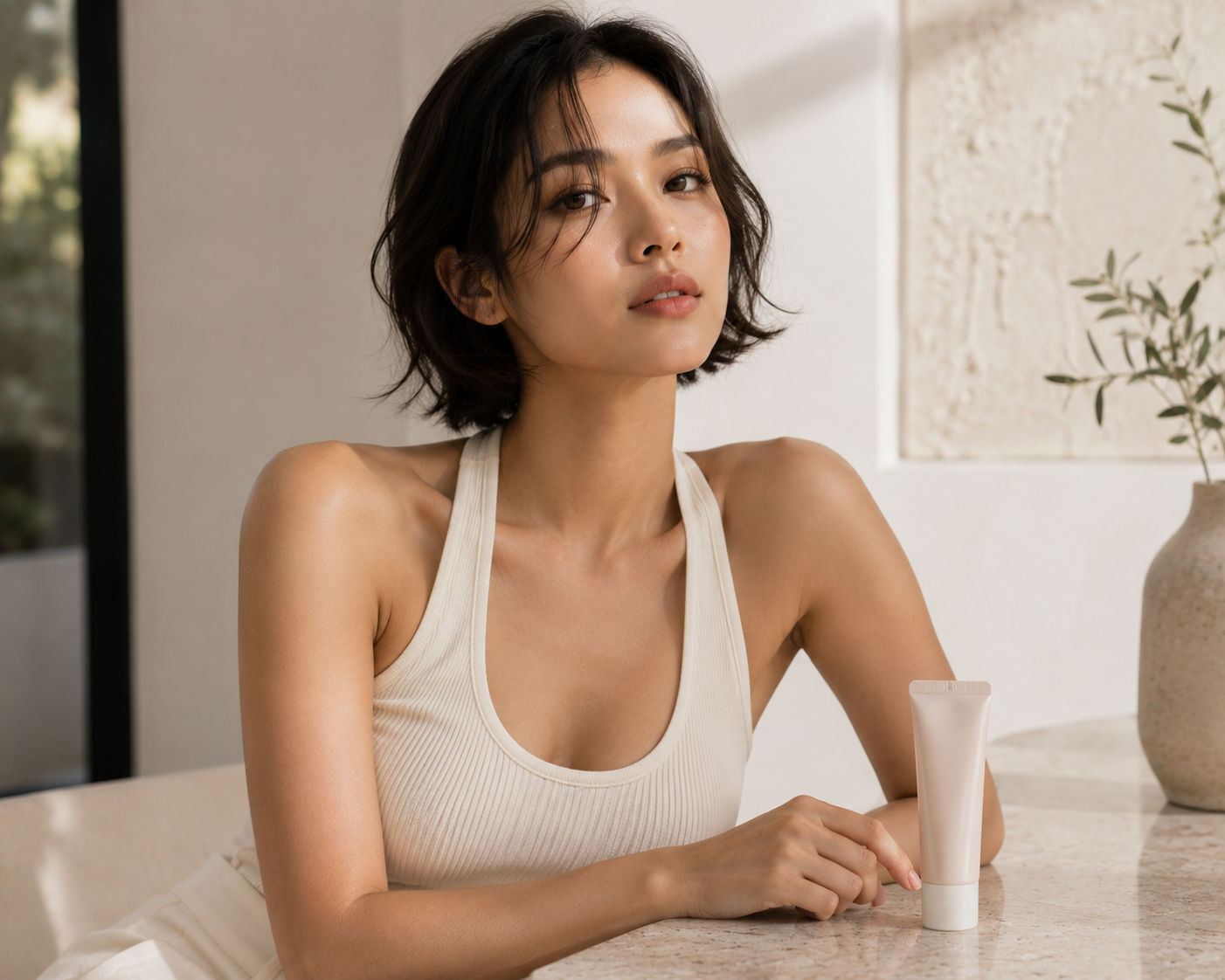
Tone-up sunscreen is a sun care product that combines SPF and UVA protection with pigments and optical correcting ingredients to instantly alleviate dullness, redness, or yellowness. Rather than providing high coverage like foundation, its purpose is to make the skin look bright and even while simplifying the next step of makeup.
The commercial viability of a product is determined not by its high SPF, but by whether it does not appear excessively white or cakey even when applied in sufficient quantities . This is because applying a small amount looks natural but makes it difficult to replicate the indicated SPF, while applying a sufficient amount can lead to significant white cast and color mismatch.
Consumers want to address sunscreen, primer, and light base makeup all at once. The main reasons for purchasing are to naturally even out dull complexion, redness, and pigmentation marks while reducing stickiness and foundation usage.
Typical complaints include a gray or pinkish white cast, unnatural brightening on dark skin, clogging of pores, flaking on dry areas, and makeup smudging. Therefore, rather than a uniform message claiming to “brighten all skin tones,” the specific purpose of tone correction and the applicable range of skin tones must be clearly presented.
Tone-up sunscreens meet the global demand for hybrid beauty that combines UV protection, skincare, and light color. While the concept of tone-up is familiar in Korea, Japan, China, and Southeast Asia, terms such as “tinted sunscreen,” “color-correcting SPF,” or “illuminating sunscreen primer” are easier to understand in North America and Europe.
The major consumers are as follows.
- Consumers who want to even out their skin tone without foundation
- People in their 20s to 40s looking to reduce preparation time for work or school
- Consumers concerned about dullness and pigmentation marks
- Consumers looking for color correcting products that make redness appear less noticeable
- Consumers who dislike the white cast and greasiness of sunscreen
- Male and genderless customers who prefer light and natural makeup
For global products, peach or beige shades with less gray undertones or transparent radiance types are more advantageous for various skin tones than a single pink shade.
Key performance features include SPF50+ and PA++++ UV protection, immediate tone evening, minimized white cast, makeup adherence, and long-lasting color stability. Glycerin, butylene glycol, and hyaluronic acid provide hydration, while niacinamide and vitamin C derivatives support skincare positioning. Immediate tone correction is primarily achieved through a combination of pigments and optical powders, such as iron oxide, titanium dioxide, and mica.
Formula Route | Product Experience | Key development conditions | Recommended market |
|---|---|---|---|
| Peach-Beige Natural Tone-Up | Less grayish and naturally evens out skin tone | Achieve color, SPF, and adhesion simultaneously with a sufficient application amount | Global No. 1 |
| Pink Dewy Tone-Up | Radiant glow and moisturizing makeup base | Fair skin tone bias and shine prevention | Korea and Japan-centered |
| Green-to-Beige Correcting SPF | Visually correct redness | Discoloration uniformity, boundary and stain prevention | Specialized for sensitive skin and redness |
| Soft-Matte No-Sebum Tone-Up | Controls sebum and shine | Prevents drying and uneven SPF film caused by excessive powder | Oily and hot/humid market |
Peach-Beige Natural Tone-Up is the most suitable for Buyer's global standard . If using a single color, reduce the degree of brightness, and if business scale permits, it is safer to expand to two colors, Light and Medium.
In addition to UV filters, the application area, purity, and country-specific acceptance of pigments must be reviewed. High levels of mineral filters and powders can increase cloudiness, dryness, and creasing in skin wrinkles, while organic and mixed filters require verification regarding eye irritation and suitability for sensitivities. For pigment raw materials, heavy metal impurity standards and supplier test reports are also subject to regulation.
market | Key regulatory points | Mandatory Validation |
|---|---|---|
| korea | Review and reporting of UV-blocking functional cosmetics and basis for SPF and PA | SPF/UVA, skin irritation, color, and safety by final color |
| USA | Sunscreen is an OTC drug; UV filters, drug facts, and efficacy testing are applied. The permitted use of dyes must also be verified. | SPF and Broad Spectrum of the final prescription for the U.S., water resistance where applicable, and color compatibility |
| EU/UK | Permitted UV Filters and Dyes, Safety Assessment and PIF/Person in Charge Requirements | Review of SPF/UVA, CPSR, Nanomaterial and Pigment Labeling and Claims |
| ASEAN | Country-specific reporting and application of the ASEAN Cosmetic Directive | High temperature stability, color change, local filter and label verification |
The most important verification principle is not to automatically apply the same SPF if the color or powder concentration changes . Since pigments and powders can affect UV transmission, film uniformity, and test results, SPF and UVA tests must be performed with the final formulation and color to be sold.
The tone-up effect can be verified through spectral color difference or immediate skin tone improvement tests under standard shooting conditions. Medicinal expressions such as “melasma removal” or “melanin treatment” should be avoided, and if long-term brightening is claimed, the immediate optical effect of tone-up must be distinguished from separate evidence of human application.
The recommended packaging is a 40–60 mL light-blocking tube or an airless pump. Tubes offer good cost-effectiveness and portability, while airless pumps are advantageous for controlling usage and preventing exposure of the contents. You must check the container material that comes into direct contact with the contents, pigment deposition, nozzle clogging, and whether oil-water separation occurs during long-term storage.
Since fluid formulations requiring shaking before use pose a risk of consumer non-compliance, formulations that dispense uniformly without separate stirring are preferable whenever possible. During export testing, color, viscosity, odor, separation, UV filtration, and container deformation are checked after high, low, and temperature cycling. The shelf life should not be determined by conventional numbers but must be finalized based on the stability data of the final formulation and packaging.
The recommended position is Masstige Daily Color-Correcting SPF . While it can command a higher price than regular sunscreens, consumers accept a price premium only when it replaces both sun care and makeup base simultaneously.
The entry-level model may feature a single peach or beige color and tube packaging, while the premium model may include two colors, an airless container, and clinical evidence based on usage results by skin tone. For the men's and genderless markets, a "matte SPF base that naturally evens out dullness and redness" is more suitable than "whitening."
- d'Alba Waterfull Tone-Up Sunscreen SPF50+ : A representative K-Beauty tone-up sunscreen that combines high UV protection, moisturizing radiance, and instant skin tone correction. The brand reports cumulative global sales of 10 million units. d'Alba Official Product Information
- Innisfree Tone Up No Sebum Sunscreen EX SPF50+ PA++++ : A soft matte benchmark combining tone-up, sebum control, and makeup primer functions. Innisfree Official Product Information
- Innisfree Vitamin C Tone Up Sunscreen SPF50+ PA++++ : An example of combining a Vitamin C-based brightening skincare message with tinted tone correction. Innisfree Official Product Information
- Dr.Jart+ Cicapair Soothing Color Correcting Treatment SPF30 : A global color-correcting benchmark combining mineral SPF with a green-to-beige color to correct redness. However, even the official description suggests application for light skin tones, demonstrating limitations in color compatibility. Dr.Jart+ Official Product Information
The competitiveness of K-Beauty lies in combining high SPF, skincare textures, and natural makeup bases into a single product. The next competitive step is not brighter tone-up, but rather color design that looks natural even when a sufficient amount is applied across various skin tones .
RFQ stage | Buyer's Decision | OEM/ODM Verification |
|---|---|---|
| Product Brief | Target country, filter root, correction color, finish, skin tone range | Ready/Semi-Custom Prescriptions Available by Country |
| Prototype | 1~2 shades, scent, moisture level, coverage level | Whitening, smudging, and color compatibility with sufficient application amount |
| Validation | SPF/UVA, tone-up, sensitive, water resistance claims | Final test rates by color, stability, container, and microbial tests |
| Commercial Quote | MOQ, Target Cost, Capacity/Container, Launch Countries/Schedule | MOQ by color, auxiliary material LT, export document and prescription change fees |
The Buyer must evaluate color samples on the entire face, not the back of the hand, using the recommended usage amount. For OEM/ODM, inquiries should be made regarding: ① MOQ per color, ② whether UV filters for the same base can be changed by country, ③ the necessity of SPF testing for each final color, ④ management of golden samples for color approval, and ⑤ acceptable standards for color difference between production batches.
MarketHub OEM/ODM & Buyer RFQ Inquiry
Contact to: mail@markethub.org
The initial RFQ recommendation is an SPF50+·PA++++ target, a single peach-beige color, a natural semi-glow, minimal fragrance, and a 50mL tube . Once the response to the first product is confirmed, it will be expanded to a Medium Beige or Green Correcting product.
The items for the Buyer to verify before commercialization are as follows.
- Can the same UV filters and dyes be used in the target country?
- Is the color natural even with a sufficient amount of sunscreen applied?
- Does a grayish tint and boundary line not appear on medium or dark skin tones, as well as on light skin?
- Has the SPF and UVA performance been verified for the final colors to be sold?
- Has the basis for skincare brightening and immediate optical tone-up been distinguished?
- Is the target retail price established including the MOQ by color and testing costs?
Since the U.S. regulates sunscreens as OTC drugs, one should not assume that prescriptions intended for Korea and the EU can be exported as is. Although the FDA added bemotrizinol to the list of permitted active ingredients for U.S. OTC sunscreens in 2026, actual prescriptions must re-verify the OTC monograph and final labeling requirements at the time of launch. FDA 2026 Announcement
Global Core: A+
The reasons for purchase—high UV protection, skin tone correction, and a shortened makeup routine—are clear. However, the single pink and white tones have low skin tone compatibility, which limits global expansion.
OEM/ODM Priority: A+ Since
UV filters, pigment dispersion, feel, and final SPF must be met simultaneously, the integrated sun care and base makeup technology of Korean OEM/ODM acts as a strength.
NoChemiLife Hero: Candidate
Peach-Beige. By ensuring low correction, minimal fragrance, natural color even with a generous application, and a proven SPF, you can become a Daily Tone-Correcting Sun Hero .
Core Evidence
- In Korea, SPF and PA labeling requires measurement results and labeling standards in accordance with the regulations on the examination of functional cosmetics. National Law Information Center—Regulations on the Examination of Functional Cosmetics
- U.S. OTC sunscreens are subject to finished product SPF testing, Broad Spectrum testing, and prescribed labeling systems. FDA Labeling and Effectiveness Testing
- In the United States, colorants must be permitted for their intended use, and some colorants must use FDA-approved batches. FDA Color Additives Summary
- UV filters and pigments in EU cosmetics are regulated under the Annex VI and Annex IV schemes of Regulation (EC) No. 1223/2009, respectively. EU Cosmetics Regulation
- Global commercial products are sold based on core values such as SPF50+, instant radiance and tone correction, and a makeup base. d'Alba Official Tone-Up Sunscreen
- Green-to-beige SPF products address the clear issue of redness correction, but they must also manage the applicable skin tone range. Dr.Jart+ Cicapair Official Information
Runtime: 2026-09-01 UTC - Cross-referenced official listing, regulation, and brand information
