


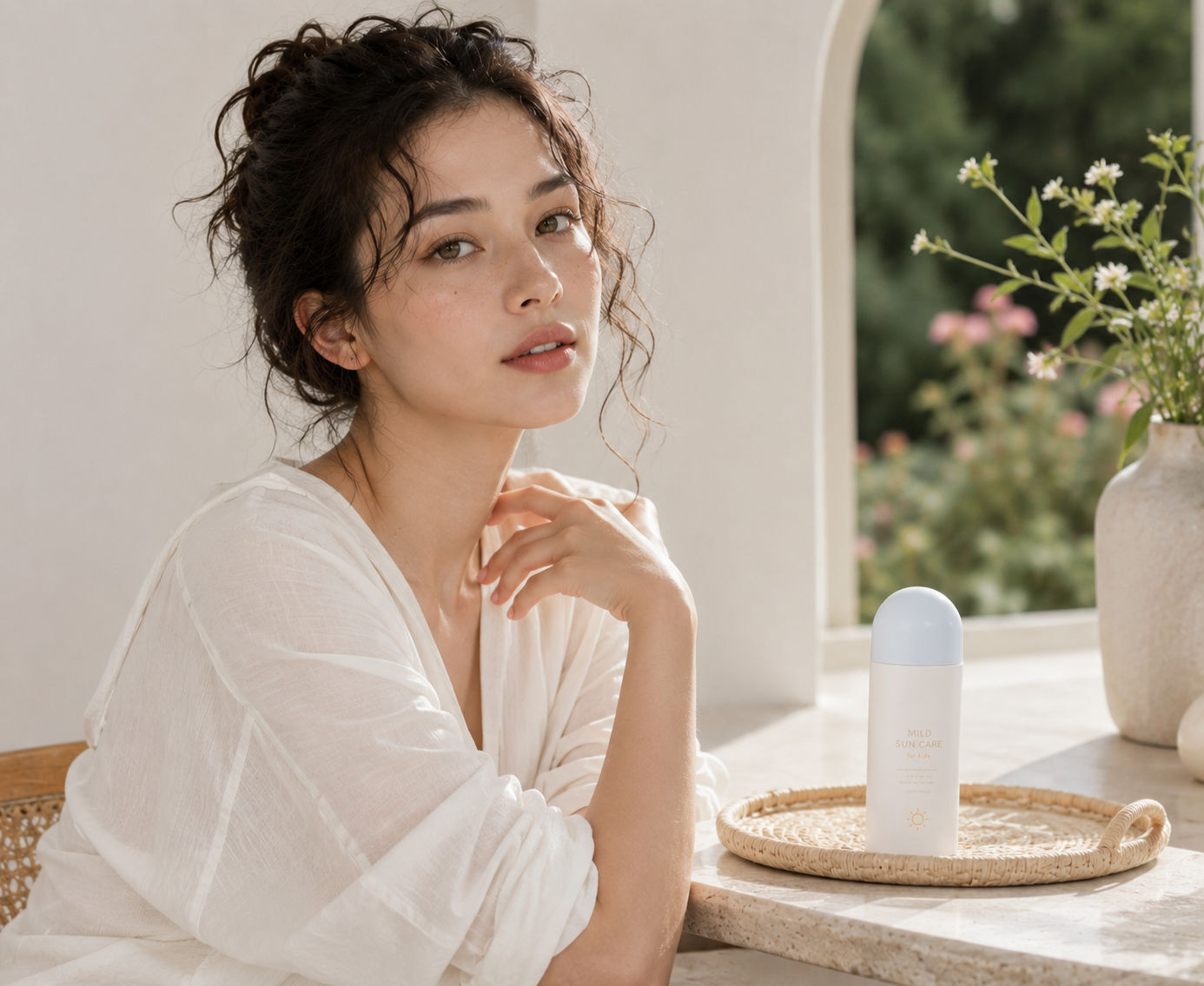
Upon comparing the official list of 112 items, No. 070 is identified as Kids Mild Sun Care, with the official code KB-RFQ-070. While Nos. 061 to 069 are sun care products focused on adult formulations and usage methods, No. 070 is a family sun care product designed based on children's skin and the guardian's usage environment.
Kids Mild Sun Care is a broad-spectrum sunscreen for use on children's faces and bodies that manages not only a high SPF but also the potential for skin irritation, ease of application, eye irritation, and ease of cleansing. In principle, the target audience is set as children aged 6 months or older .
'Baby,' 'Kids,' and 'Mild' do not imply UV protection performance. The American Academy of Dermatology explains that in the United States, the terms 'baby' and 'sensitive skin' for sunscreens are not separately defined by the FDA. Therefore, product suitability must be demonstrated through age labeling, fragrance-free and hypoallergenic design, and final product testing.
Buyers want products that reduce children's exposure to sunlight during outdoor activities without causing them to cry or avoid application, do not cause severe stinging when their eyes are rubbed, and maintain protection even after sweating or playing in the water. Since the actual buyer is the guardian rather than the child, product selection is determined by understanding the ingredients, ease of application, washability, and reliable usage instructions, along with UV protection performance.
Major complaints include the severe cloudiness and stiffness of mineral products, as well as transferring onto clothes and strollers, and the eye irritation, stickiness, and sand adhesion of organic filter products. Since caregivers often apply only a small amount or miss exposed areas, a texture that spreads easily and allows the application to be briefly visible may actually be more beneficial for protection during actual use.
The demand for kids' sun care is a recurring trend based on outdoor activities, family travel, and sensitive skin care, rather than an independent beauty trend. In North America, Europe, and Australia, broad spectrum, water resistance, and clear usage instructions are important, while in Asia, SPF50+ and PA++++, a texture with minimal white cast, and ease of daily washing significantly influence purchasing decisions.
The main target consumers are as follows.
- Guardians of infants and children aged 6 months or older
- Daycare, kindergarten, and school outdoor activities at home
- A family that frequently engages in water activities, camping, and sports.
- Families with sensitive skin who want to avoid fragrances and eye irritation
- Buyers of family sunscreen for adults and children
Infants under six months of age should be excluded from the core target audience for sunscreen sales, and guidance should prioritize shade, hats, and protective clothing. The FDA also generally does not recommend sunscreen for this age group without consulting a doctor.
Key performance features include UVA/UVB protection targeting SPF50+·PA++++, sufficient spreadability, low eye irritation and skin irritation, and water resistance suitable for outdoor activities. The mineral route is centered on zinc oxide and titanium dioxide, while glycerin, panthenol, allantoin, and oat-derived ingredients can be utilized as auxiliary routes to alleviate dryness and irritation.
Formula Route | Consumer Value | Key conditions for development | RFQ Conformity |
|---|---|---|---|
| Mineral Mild Lotion | Clearly positioned for sensitive skin, fragrance-free, and kids. | ZnO/TiO₂ dispersion improves cloudiness, stiffness, and stain resistance. | 1st Priority—Kids Core Type |
| Lightweight Hybrid Milk | Spreadability, transparency, and rapid application to large areas | Filters allowed by target country, verified for eye irritation and stinging | 2nd Place—Family Global Type |
| Water-Resistant Outdoor Cream | Water activities and sports sustainability | Water resistance test, balance of cleaning performance and film formation | 3rd Place—Outdoor Specialized |
| Mineral Stick | Local portable use on the nose, cheeks, ears, etc. | Management of repetition counts and omissions | Secondary SKUs—Excluding standalone mainstays |
First, the recommended formula is a Mineral Mild Lotion that excludes fragrances and colorings . However, safety should not be assumed solely based on the fact that it is a 'mineral' product; usability that allows for easy application of a sufficient amount and final product irritation testing must also be ensured.
Since children may touch their faces with their hands or bring hands contaminated with the product to their mouths, the potential for misuse around the eyes and mouth, as well as the levels of fragrances, essential oils, and alcohol, are reviewed conservatively. Aerosol and powder forms are not recommended as initial Kids SKUs due to concerns regarding inhalation and incomplete application.
market | Key Points of Regulation and Labeling | Mandatory Validation |
|---|---|---|
| korea | Review and reporting of functional cosmetics with UV protection, basis for SPF and PA | When claiming final product SPF/UVA, skin irritation, or water resistance, the relevant test |
| USA | Sunscreen is an OTC drug; subject to permitted active ingredients, drug facts, and Broad Spectrum regulations. | Prescription SPF, Broad Spectrum, Water Resistance, Age, Warnings for the U.S. |
| EU/UK | Permitted UV filters under cosmetic regulations, application of safety evaluation, PIF, and responsible person | SPF/UVA, CPSR, Nanomaterials, and Safety Review for Children |
| ASEAN | Country-specific reporting and application of the ASEAN Cosmetic Directive | High temperature stability, local filter/labeling, and waterproof claims verified |
Mandatory tests include SPF and UVA protection of the final formulation and packaging, microbial limits and preservation, primary skin irritation, stability, and container conformity. To label products as “no eye irritation,” “tear-free,” “hypoallergenic,” or “for sensitive skin,” supporting evidence must be secured for the corresponding finished product. For water use, water resistance testing is required in accordance with the methods and labeling times specified by the target country.
Even children's products do not provide complete protection with sunscreen alone. Guardians must apply a sufficient amount before sun exposure, reapply after swimming, sweating, or using a towel, and use it in conjunction with shade, clothing, and hats.
For primary packaging, a 50–80 mL flip-top tube or locking pump that is easy for a caregiver to use with one hand is suitable. For products applied to both the face and body, an excessively small volume can lead to insufficient application, so a balance between portability and single-use amount is required.
The container must not have sharp edges, the cap must not detach easily, and it must be difficult for a child to arbitrarily dispense a large amount. While animal characters and colors can enhance friendliness, designs that cause the product to be mistaken for food or a toy should be avoided.
The shelf life is determined based on the final formulation and packaging stability data. For export products, separation, viscosity, odor, cloudiness, and UV performance after high, low, and temperature cycling are verified, and leakage and drop tests considering use on beaches, in vehicles, and in bags are also included.
The recommended positioning is Masstige Family-Safe Outdoor SPF . Rather than simply relying on the sentiment that it is "gentle for children," the basis for the premium price should be grounds in its standard for use from 6 months of age and up, fragrance-free design, Broad Spectrum SPF, UVA protection, and water resistance.
The first product can be introduced as a lotion for both face and body, and can subsequently be expanded to portable sticks and large-capacity family products. The lotion and stick are configured as a set, but it is clearly indicated that the stick is intended for facial contours and reapplication assistance.
- La Roche-Posay Anthelios Gentle Lotion Kids Sunscreen SPF50 : A mineral lotion for children that combines blending for various skin tones with 80-minute water resistance according to U.S. standards. La Roche-Posay Official Product Information
- Aveeno Kids Continuous Protection Mineral Sunscreen SPF50 : A product combining a zinc oxide, oat, and fragrance-free formula with a sensitive skin profile. Aveeno Official Product Information
- Aveeno Kids Mineral Sunscreen Stick SPF50 : An auxiliary benchmark representing the market for localized areas of the face and body, as well as portable reapplication. Aveeno Official Product Information
- ATOPALM Zinc Mild Up Sun Cream SPF50+ PA++++ : This is a Korean kids and family sun care channel that combines mineral filters with a sensitive skin image. In the export RFQ, instead of the sales outlet indication, the manufacturer's test data and the final formulation for each country must be verified separately.
The competitiveness of K-Beauty lies in its ability to improve high-protection sun care with a light and moisturizing texture and expand into various containers such as kids' lotions, compacts, and sticks. However, to become a global hero, sufficient spreadability, water resistance, and age-specific usage guidelines must be prioritized over characters or 'mild ingredients. '
RFQ stage | Buyer Confirmation | OEM/ODM Verification |
|---|---|---|
| Product Brief | Target age, target country, filter type, face/body, water resistance | Country-specific prescriptions, experience in kids' sun care production and export |
| Prototype | Allowable level of white cast, fragrance, viscosity, cleaning sensation, container | Recommended amount spreadability, usability around the eyes, filter dispersion stability |
| Validation | SPF/UVA, Water Resistance, Hypoallergenic · No Eye Irritation Claim | Test methods, institutions, costs, finished product basis, and impact of changes |
| Commercial Quote | MOQ, Target Cost, Volume, Main Product/Stick Composition | Subsidiary MOQ·Lead Time, Production LT, Export Documents |
When making an OEM/ODM inquiry, you must check ① whether the formulation is suitable for the target age group and target country, ② whether filters for the US and Korea/EU need to be separated, ③ whether there is data on the SPF, UVA, and water resistance of the final product, ④ the actual basis for proposed claims such as 'tear-free, hypoallergenic, pediatric tested', and ⑤ spreadability and recommended single dose.
MarketHub OEM/ODM & Buyer RFQ Inquiry
Contact to: mail@markethub.org
The first RFQ recommendation is for infants aged 6 months and older, target SPF50+·PA++++, fragrance-free mineral lotion, suitable for face and body, natural white cast, and a 60mL flip-top tube. If water play is set as the core usage scenario, water resistance targets and cleaning guidelines are specified in a separate Product Brief.
The key Go/No-Go conditions for commercialization are as follows.
- Are the target age and application area clear on the label?
- Even if you apply a sufficient amount, is it not excessively thick or white?
- Has SPF, UVA, and water resistance been proven in the final formulation?
- Is there evidence from the finished product for key claims such as eye irritation and low irritation?
- Can the same prescription be used in the US, EU, and Asia?
- Is it a container designed with child safety and guardian convenience in mind?
- Does the target consumer price hold true including testing costs and container MOQ?
The U.S. FDA added bemotrizinol as an approved active ingredient for OTC sunscreens for adults and children 6 months of age and older in 2026. While this has expanded the organic and mixed filter routes for the U.S., it is appropriate to compare prescription possibilities by country while keeping the primary recommended direction for 'kids' products still the mineral route, which has high market credibility.
Global Core: A+
Children's UV protection is a seasonal but recurring demand that transcends countries and distribution channels. It has high scalability for family use and outdoor applications.
OEM/ODM Priority: A+
Since UV filter dispersion, hypoallergenic feel, water resistance, and the need for country-specific formulation adaptation are required, it is advantageous to leverage the sun care development capabilities of Korean OEM/ODMs.
NoChemiLife Hero: Candidate.
If you provide transparent information on the target age, sufficient application method, and test evidence based on a fragrance-free mineral lotion, you can become a Family Mild Sun Hero .
Core Evidence
- The FDA generally does not recommend sunscreen for infants under six months of age, advising instead to prioritize sun avoidance and protective clothing. FDA—Should You Put Sunscreen on Infants?
- The AAD recommends zinc oxide or titanium dioxide products for children 6 months of age and older, and explains that 'baby' is not a term separately defined by the FDA. AAD—How to Decode a Sunscreen Label
- The FDA advises using Broad Spectrum sunscreen as directed and reapplying it at least every two hours, and more frequently after swimming or sweating. FDA—Sunscreen Protection
- Korean SPF and PA labeling is subject to test results and labeling standards in accordance with the Functional Cosmetics Examination Regulations. National Law Information Center—Regulations on the Examination of Functional Cosmetics
- In the EU, UV filters that can be used in cosmetics are regulated by the Cosmetics Regulation Annex VI. European Commission—CosIng Annex VI
- The FDA added bemotrizinol as an approved active ingredient for OTC sunscreens for adults and children 6 months and older in 2026. FDA—Sunscreen Options Expansion
Runtime: 2026-09-01 UTC Comparison of official lists, regulations, and product information
